

Children growing up with AI have something no earlier generation had: a tool that talks back, answers instantly, and can act like a friend. For most kids, everyday uses like homework help or asking a chatbot a curious question appear to carry modest risk when an adult stays involved. The bigger concerns are emotional attachment to companion-style chatbots, using AI to skip thinking instead of support it, and exposure to harmful or inaccurate content. These risks are higher for younger children and for kids who are already lonely or struggling.
The research is still young, so no one can give you a precise “safe” number of minutes. What you can do is understand where the real risks are, spot warning signs early, and set rules that fit your child’s age. This guide covers all three.
Key Takeaways
- AI time limits: There is no universal daily time limit specifically for generative AI chatbots established by the pediatric guidance reviewed for this article. Families can use age-appropriate media rules and ensure AI does not interfere with sleep, schoolwork, exercise, or relationships. The AAP Family Media Plan offers practical guidance for setting family technology rules.
- AI companions: Social AI companions can encourage emotional attachment and create risks for young users. In its 2025 risk assessment, Common Sense Media recommended that AI companions not be used by anyone under 18.
- Most general chatbots set a minimum age of 13, and some require parental consent until 18. Several, including Claude, are 18+ only.
- Getting answers is different from getting help. Early research suggests unrestricted answer access can weaken learning, while tutor-style tools that give hints appear less harmful.
- Watch for patterns, not single moments: secrecy, preferring the chatbot to people, distress when access is removed, and late-night use.
Where Kids Are Meeting AI Today
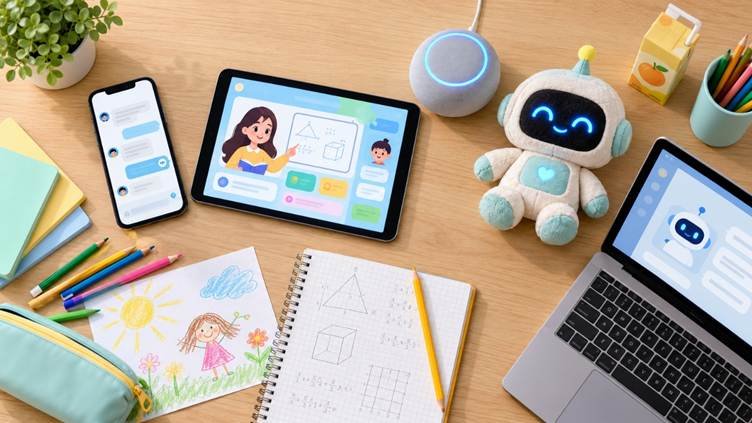
Many parents picture ChatGPT when they think of kids and AI chatbots. In reality, children often meet AI inside apps they already use, sometimes without realizing it.
| Type of AI | Common examples | What to watch |
| General chatbots | ChatGPT, Gemini, Copilot, Claude | Age minimums (13+ for most, 18+ for some); wrong answers delivered confidently |
| AI inside social and messaging apps | Snapchat’s My AI, Meta AI in Instagram and WhatsApp | Feels like texting a friend; kids may not register it’s a program |
| Companion and character apps | Character.AI, Replika, and similar | Designed for ongoing relationships; highest emotional risk |
| Homework and tutoring tools | AI features in learning platforms, photo-solve apps | Can replace thinking rather than support it |
| AI toys and voice assistants | Smart speakers, talking AI toys | Young kids may believe the toy “knows” or “likes” them; voice data privacy |
AI platforms can change their age policies and safety features quickly. In October 2025, Character.AI announced changes to its under-18 experience, including plans to end open-ended chat for users under 18. Parents should check the platform’s current age requirements and safety policies before allowing children to use it.
What the Research Says, and How Strong It Is
AI chatbots only went mainstream in late 2022, so there are no long-term studies following children who grew up using them. What exists today comes from surveys, short experiments (often with teens or adults), research on older technology like smart speakers and social media, and safety testing by watchdog groups.
That means some claims are much better supported than others:
| Claim | Strength of evidence |
| Young children tend to treat talking devices as social beings | Reasonably supported (research on voice assistants and robots) |
| Chatbots sometimes give harmful replies on self-harm, eating, or drugs | Reasonably supported (independent safety testing) |
| Unrestricted answer access can weaken learning | Emerging (a small number of trials, mostly teens) |
| Companion chatbots can encourage emotional dependence | Emerging (surveys, user reports, and how apps are designed) |
| AI use causes anxiety or depression in children | Not established; no good evidence either way yet |
Keep this table in mind when you read alarming headlines or glowing product claims. Both tend to run ahead of the evidence.
The Real Benefits

AI is not only a risk to manage. Used well, it can do things that genuinely help kids learn.
Patient, on-demand explanations. A chatbot can explain fractions five different ways without losing patience. For kids who are embarrassed to ask in class, that can lower the barrier to learning.
Accessibility support. Text-to-speech, reading-level adjustments, and step-by-step task breakdowns may help children with dyslexia, ADHD, or a home language other than English. Research on AI specifically for these groups is limited, but these supports build on accommodations that already exist.
Curiosity and creativity. Kids can brainstorm story ideas, ask endless “why” questions, or practice a new language in conversation.
AI literacy itself. Your child will almost certainly use these tools as an adult. Learning with guidance now builds the judgment they’ll need later, like knowing when an answer looks wrong.
The Main Risks
Emotional attachment and AI companions

Chatbots are built to be agreeable, always available, and never bored. For a lonely or anxious child, that can feel easier than real friendships, which involve disagreement, waiting, and repair. Those uncomfortable parts are exactly how kids build social skills.
A 2025 Common Sense Media national survey of US teens aged 13–17 found that 72% had used an AI companion at least once. About one-third reported using AI companions for social interaction and relationships, including friendship, emotional support, and conversation. These findings describe teen experiences and do not establish the effects of AI companionship on younger children.
In September 2025, the US Federal Trade Commission announced an inquiry into AI chatbots acting as companions. The inquiry sought information from seven companies about how they assess potential harms to children and teens, enforce age restrictions, and handle users’ personal information. The inquiry itself does not establish that a particular chatbot caused a specific injury.
Critical thinking and learning
The risk here is “cognitive offloading,” which means letting a tool do mental work you’d otherwise do yourself. Some offloading is fine (nobody needs to do long division by hand forever). The problem is when kids skip the struggle that actually builds understanding.
A 2025 randomized field experiment published in the Proceedings of the National Academy of Sciences examined GPT-4 use among high-school mathematics students. Students with unrestricted AI assistance performed better during practice but experienced lower performance on a subsequent exam without AI access. A tutor version designed to provide hints largely avoided this decline. The findings suggest that AI can support learning when it guides students rather than simply supplying answers. Read the original research paper.
Inaccurate, biased, or harmful content
Chatbots can “hallucinate,” meaning they produce false information that sounds confident and specific. Children are less equipped to catch these errors.
Independent safety testing has identified serious shortcomings in AI chatbots used for mental health support. In its November 2025 assessment, Common Sense Media’s Youth AI Safety Institute reported failures in how tested chatbots handled a range of mental health concerns affecting teens. These findings support caution and adult involvement; they should not be interpreted as evidence that every chatbot produces harmful responses in every interaction.
Privacy and data
Kids often share names, schools, feelings, and photos with chatbots as if talking to a friend. Depending on the company, conversations may be stored, reviewed, or used to train future models. AI toys and smart speakers can record voices in the home. Children under 13 have extra legal protections in the US and UK, but those rules depend on companies following them.
AI and Children’s Mental Health: What We Know So Far
Research on the long-term mental health effects of generative AI use in children remains limited. Available safety assessments have identified concerns about chatbots providing mental health guidance, but these findings do not establish that AI use directly causes anxiety or depression in children. Parents should pay attention to changes in sleep, social connection, mood, and everyday functioning. For further context, see Common Sense Media’s assessment of AI chatbots for mental health support.
- Displacement. Time with AI can crowd out sleep, physical activity, and in-person time, all of which support children’s mental health.
- Replacing human support. A child who turns to a chatbot instead of a parent, friend, or counselor may not get help that a person would notice they need.
- Mishandled disclosures. A general chatbot isn’t designed or regulated as mental health care. It may miss signs of crisis or respond poorly.
- Agreeableness. Chatbots tend to validate whatever the user says. For a child with anxious or negative thinking, that can reinforce distorted beliefs instead of gently challenging them.
Kids who are already anxious, depressed, socially isolated, or neurodivergent may be more drawn to AI companionship and more vulnerable to these effects. On the other hand, some children use chatbots in harmless or even helpful ways, like rehearsing a hard conversation before having it with a real person. Context and pattern matter more than the fact of use.
Warning Signs to Watch For

No single sign proves a problem. What matters is a pattern, especially a change from how your child usually behaves.
- Secrecy about AI use, or quickly switching screens when you walk in
- Calling a chatbot their best friend, boyfriend, or girlfriend
- Preferring to talk to the AI over family or friends
- Strong distress or anger when access is limited
- Using AI late at night or losing sleep over it
- Pulling back from activities or friendships they used to enjoy
- Relying on AI for nearly every assignment and struggling without it
- Repeating unusual, sexual, or harmful ideas they picked up from a chatbot
If you notice several of these, start with a calm, curious conversation rather than an immediate ban. Abrupt removal can push use underground.
How Much AI Use Is Okay for Kids?
There isn’t an official number, and anyone offering one is going beyond the evidence. A more useful question is whether AI use fits your child’s age and stays out of the way of sleep, schoolwork they do on their own, physical activity, and time with people.
The framework below is an editorial guide based on general child development principles and platform age minimums. It is not an official guideline.
| Age | Reasonable approach |
| 5–7 | Only with an adult, on a shared device. Simple questions or voice assistants. Explain that AI is a computer program, not a person. |
| 8–10 | Supervised use for specific tasks, like checking homework or exploring a question. Shared spaces only. Kid-focused tools with guardrails. No companion apps. |
| 11–12 | More independence for learning tasks, with agreed rules. Still below the 13+ minimum for most chatbots. Regular talks about accuracy and privacy. |
| 13–14 | Own accounts possible, with parental controls where offered. Regular check-ins about how they use it, including emotional use. Still no companion apps. |
The [INTERNAL LINK: AAP Family Media Plan] tool can help you fold AI into the screen rules your family already has.
A Simple Family Plan for Parenting in the Age of AI

You don’t need to become an AI expert. These steps cover most households.
- Find out what they’re using. Ask, and check their apps. Include AI built into Snapchat, Instagram, games, and school platforms.
- Try the tools together. Ask a chatbot something you know the answer to and see if it gets it right. This makes “AI can be wrong” concrete.
- Keep use in shared spaces. Avoid AI use in bedrooms, especially at night.
- Set a homework rule. Something like “try it yourself first, then ask AI to explain, not to answer.” Check your school’s AI policy too.
- Keep companion apps off the list for kids under 18, and use app store age ratings and parental controls. See [INTERNAL LINK: Parental Controls for AI Apps: A Step-by-Step Setup Guide] and [INTERNAL LINK: Is ChatGPT Safe for Kids?].
- Teach three quick questions: Is this true? Who made this tool? Would I tell a real person this?
- Make it safe to tell you. Promise you won’t overreact if they report something strange or upsetting a chatbot said.
- Revisit every few months. Apps and your child both change.
For a printable version, see [INTERNAL LINK: Family AI Rules: A Template for Every Age].
Child-Safety Organizations by Country
Rules on AI and children are changing quickly in every region. These organizations publish current guidance for parents.
| Country | Key organizations | Recent developments |
| United States | American Academy of Pediatrics (AAP), Federal Trade Commission (FTC) | FTC inquiry into AI companions; several states passing companion chatbot laws |
| United Kingdom | NSPCC, Ofcom, Information Commissioner’s Office (ICO) | Online Safety Act child-safety duties, which Ofcom has said can cover some AI chatbots |
| Canada | Canadian Paediatric Society, Canadian Centre for Child Protection | Privacy Commissioner guidance on children’s data |
| Australia | eSafety Commissioner | Industry codes covering AI companion chatbots; social media minimum age of 16 from December 2025 |
When to Get Professional Help
Talk to your child’s pediatrician, family doctor, school counselor, or a mental health professional if warning signs last more than a couple of weeks, or if you notice withdrawal from friends, falling grades, sleep problems, or ongoing low mood. Seek help sooner if a chatbot has encouraged self-harm, exposed your child to sexual content, or if your child seems unable to cut back.
FAQ
Is it okay for my child to use ChatGPT for homework?
ChatGPT is not intended for children under 13. Users aged 13–17 must have permission from a parent or legal guardian. For school use, children should follow their school’s AI policy and use eligible tools to understand concepts, check their work, and learn rather than simply submit AI-generated answers. Review the current OpenAI age and safety guidance before publication.
Can I turn off Snapchat’s My AI?
Snapchat’s Family Center has offered parents options to limit My AI for teen accounts. Even with limits, talk with your child about the fact that My AI is a program, and that what they share with it may be stored.
Can an AI chatbot help my anxious child instead of therapy?
General-purpose AI chatbots should not replace professional mental health care for a child. Safety testing has identified limitations in how chatbots handle mental health concerns, including anxiety, depression, and other conditions. If your child is struggling, consult a pediatrician or qualified mental health professional. See Common Sense Media’s AI mental health chatbot assessment.
My child says an AI is their best friend. Should I take it away?
Try understanding before removing. Ask what they like about it, since the answer often reveals an unmet need, like loneliness or a friendship problem at school. Then gradually limit use while helping them build real-world connections. If the attachment seems intense, or they become very distressed, speak with a professional.
Are AI toys safe for young children?
Young children are more likely to believe a talking toy has feelings, and many AI toys record voices and send data to company servers. Before buying, check what the toy records, where data goes, and whether you can delete it. Keep use supervised.
Where This Leaves Parents
AI is now part of childhood, and banning it outright is neither realistic nor clearly necessary. The evidence so far points to a few specific risks worth taking seriously: companion apps, AI that replaces thinking, and chatbots standing in for human support. Most families can manage those with age-appropriate rules, open conversation, and attention to changes in their child’s behavior. Your involvement remains the most reliable safety feature available.