
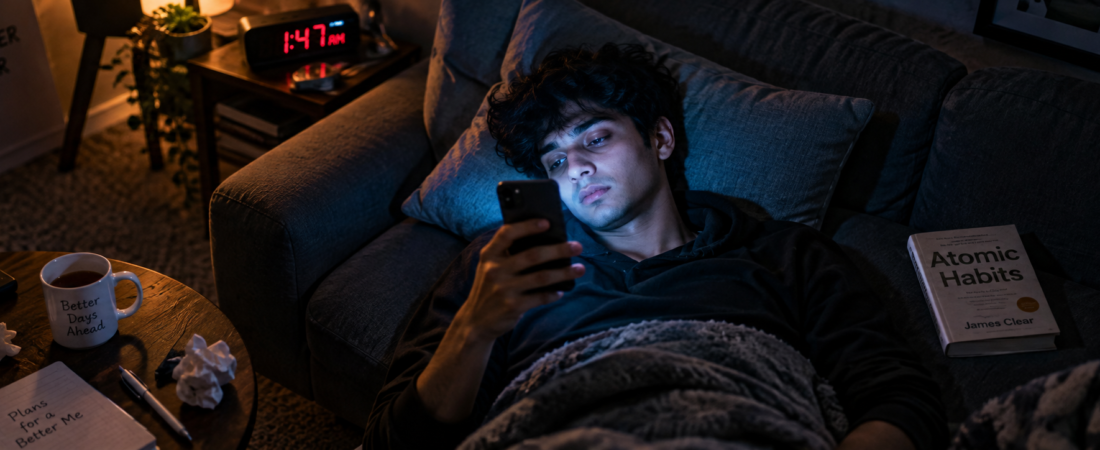
You pick up your phone to check one notification. Forty-five minutes later you’re three articles deep into something upsetting, your neck hurts, and you have no idea how you got there. That’s doomscrolling, and if you’re looking for a doomscrolling recovery guide for beginners, here’s the short version: you don’t need more willpower, you need to interrupt the loop before it starts, replace the habit with something that actually satisfies the same itch, and rebuild your phone’s environment so the easy option isn’t “scroll for 40 minutes.” That’s it. Everything else in this guide is just the how.
Key Takeaways
- Doomscrolling is a dopamine-driven habit loop, not a character flaw — you’re not “weak,” your brain is doing exactly what it’s built to do with an app designed to exploit that.
- The fastest wins come from friction (making scrolling slightly harder) and substitution (giving your hands something else to do), not from banning your phone entirely.
- Most people relapse because they try to quit cold turkey. A phased plan works better than an all-or-nothing rule.
- Anxiety often causes doomscrolling, not the other way around — so managing the anxiety underneath matters as much as the phone habit itself.
- Recovery is measured in fewer/shorter sessions, not zero scrolling ever again.
Why Do I Doomscroll When I’m Anxious?
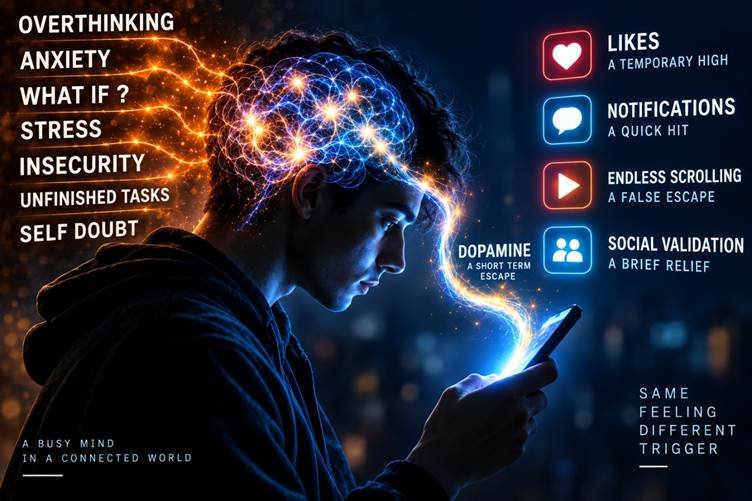
Here’s the honest answer nobody tells you at first: doomscrolling isn’t really about the news or the content. It’s about your brain looking for relief from a feeling it doesn’t know how to sit with.
When you’re anxious, your body is on alert, scanning for threats. Scrolling can feel like you’re doing something about that alert state, even when it isn’t actually resolving the underlying feeling. Each new post creates another opportunity for something interesting, surprising, upsetting, or rewarding to appear, which can encourage continued engagement. Research on social-media behavior suggests that engagement can follow principles of reward learning, with users’ behavior influenced by the rewards they receive from online interactions. Lindström et al. (2021) – Nature Communications.
The problem is the relief is fake. You’re not resolving the anxiety, you’re just distracting from it for a few seconds at a time, over and over. And a lot of what you’re scrolling through — conflict, disaster, outrage — is specifically the kind of content that keeps your nervous system activated, which is why you often end a scrolling session feeling more wound up than when you started, not less.
I’ll push back on one popular idea here: a lot of advice treats doomscrolling like a simple discipline problem — just put the phone down. That ignores that you’re reaching for it because you’re anxious in the first place. Fix only the scrolling and leave the anxiety untouched, and you’ll find another outlet for it. Fix both, and the habit actually loosens.
What Is Doomscrolling? (And Is It Different From Normal Phone Use?)
Doomscrolling is the habit of continuing to scroll through negative, distressing, or attention-grabbing content — news, social feeds, comment sections — well past the point where it’s useful or enjoyable, usually without a clear decision to stop.
It’s different from normal phone use in three specific ways:
- It’s not goal-directed. You didn’t open the app to find something. You opened it to not feel something.
- It doesn’t end when the need is met. Checking the weather ends when you have the forecast. Doomscrolling has no natural stopping point, which is why it eats 20, 40, sometimes 90 minutes without you noticing.
- It reliably leaves you feeling worse, not neutral or better — more anxious, more tired, more behind on whatever you were actually supposed to be doing.
If you’ve ever looked up from your phone and thought “wait, why do I feel worse than before I picked this up,” that’s the tell. Normal scrolling doesn’t do that consistently.
Signs You’re Addicted to Your Phone (Not Just “On It A Lot”)
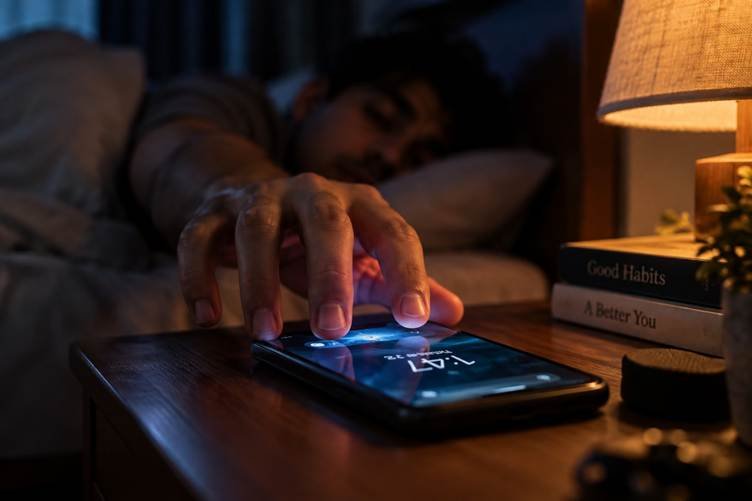
Being on your phone a lot isn’t automatically a problem — plenty of people use their phones heavily for work, creative projects, or genuinely enjoyable connection. What separates heavy use from something closer to addiction is whether you have control over it. A few signs worth paying attention to:
- You reach for it automatically, before you’ve consciously decided to — often within seconds of a lull in activity (elevator, red light, ad break).
- You’ve tried to cut back and it didn’t stick, or it lasted a few days before sliding back to baseline.
- You feel a small jolt of anxiety or restlessness when you can’t check your phone (dead battery, no signal, left it in another room).
- You lose track of time consistently — “quick check” regularly turns into 30+ minutes.
- It’s affecting your sleep, either because you’re scrolling in bed or because your mind is too activated afterward to fall asleep easily.
- You scroll during things that used to hold your attention on their own — conversations, meals, TV shows you actually like.
None of these on their own mean much. If you’re nodding along to three or four of them, though, it’s worth treating this as a real habit to work on rather than a minor annoyance.
If checking your phone feels less like a choice and more like a compulsion you can’t skip, and it’s affecting your daily functioning, sleep, or mood in a significant way, it’s worth talking to a doctor or therapist rather than trying to white-knuckle it alone.
How to Break the Doomscrolling Habit: A Step-by-Step Plan
This is the part people usually skip to, so here it is — but read the “why” sections above if you skipped them, because the plan works a lot better once you understand what you’re actually fighting.
Step 1: Track it for three days before you change anything
Most phones already do this for you (Screen Time on iOS, Digital Wellbeing on Android). Don’t judge the number yet — just look at it. People often underestimate how much time they actually spend on their smartphones. Research comparing self-reported smartphone use with objectively recorded usage has found meaningful discrepancies between what people remember reporting and what their devices actually record. Lee et al. (2017) – Psychiatry Investigation Seeing your actual usage can therefore give you a more realistic starting point for changing the habit.
Step 2: Add friction, don’t add bans
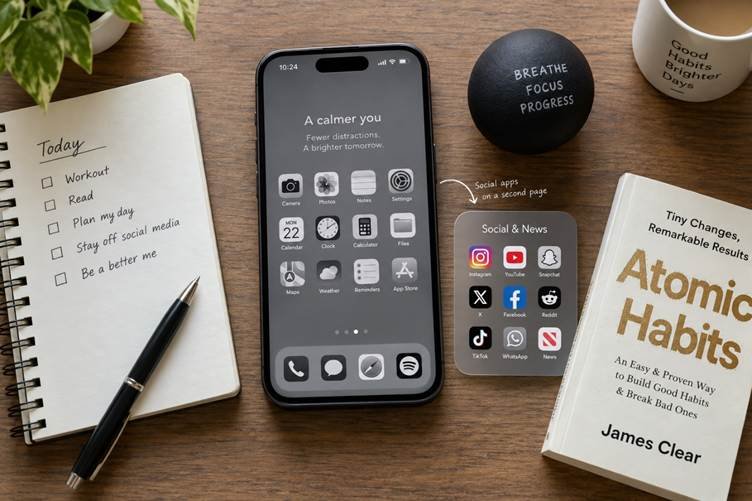
Deleting every app cold-turkey usually backfires — you either reinstall it in a week or find something equally bad to fill the gap. Friction works better because it interrupts the automatic part of the habit without requiring willpower in the moment.
- Move social and news apps off your home screen into a folder on page two or three.
- Turn off badge notifications (the red dots) — they’re a bigger trigger than most people realize.
- Set your phone to grayscale during certain hours. It sounds gimmicky, but a lot of the pull is visual, and gray feeds are noticeably less compelling.
- Use a simple screen-time limit app that makes you wait 10-15 seconds before opening the app. That pause is often enough to break the automatic reach.
Step 3: Give your hands and eyes something else to do
This is the step most guides skip, and it’s the one that actually matters most. You’re not just quitting an app — you’re removing a coping tool, so you need to replace it with something, or your brain will just find a new bad option.
Keep something within arm’s reach for the exact moments you’d normally grab your phone:
- A physical book or a puzzle app with no infinite scroll.
- A stress ball, fidget object, or something to knit/doodle.
- A specific 2-minute breathing pattern for the anxious moments (box breathing — 4 seconds in, 4 hold, 4 out, 4 hold — is simple enough to actually remember and use).
Step 4: Set “scroll windows” instead of a total ban
Pick two or three set times a day — say, 20 minutes at lunch and 20 minutes in the early evening — where scrolling is fully allowed, guilt-free. Outside those windows, the apps are off-limits.
This works better than an all-day ban for two reasons: it doesn’t create the “forbidden fruit” effect that makes people binge later, and it gives your brain a predictable outlet, which lowers the anxious urge to check “just in case” throughout the day.
Step 5: Change your bedroom rules specifically

Phone-in-bed scrolling deserves its own fix because it can interfere with sleep. Evening exposure to light from electronic displays can affect the body’s sleep-related processes, including melatonin regulation and the time it takes to fall asleep. In a controlled study, higher evening melanopic light exposure was associated with longer sleep latency, reduced melatonin concentration, and delayed melatonin onset. Schöllhorn et al. (2023) – Communications Biology Charge your phone outside the bedroom, or at minimum across the room, rather than keeping it on your nightstand.
Step 6: Expect relapse, and don’t treat it as failure
You will have a 90-minute scroll session at some point. That’s not the plan not working — that’s what habit change actually looks like. The goal isn’t a perfect streak, it’s a lower average over weeks, not days.
[Internally link to: article on managing stress and anxiety without medication]
Simple Ways to Stop Doomscrolling Today (If You Need Something Right Now)

If you’re in the middle of a scroll spiral right now and don’t need the whole plan, here’s what actually interrupts it in the moment:
- Stand up. Physically changing position breaks the trance more reliably than trying to “decide” to stop.
- Name what you’re feeling out loud — “I’m anxious” or “I’m bored.” It sounds small, but naming the emotion pulls you out of autopilot.
- Put the phone in another room for 10 minutes, not forever — just long enough to break the loop.
- Text a real person instead of scrolling — a short message to a friend does more for your nervous system than another 20 headlines.
When Doomscrolling Might Be a Bigger Issue
For most people, doomscrolling is a habit — annoying, tiring, worth fixing, but not a medical problem. For some people, though, it overlaps with generalized anxiety, insomnia, or depression, and the phone use is more of a symptom than the root cause.
If you’ve tried structural changes like the ones above for a few weeks and nothing sticks, or if the anxiety underneath feels bigger than “checking the news too much,” that’s worth bringing to a doctor or therapist. There’s no shame in that — a habit that resists every practical fix is usually telling you something else is going on underneath it.
FAQ
How long does it take to break a doomscrolling habit?
There is no fixed number of days required to change a habit. Research on habit formation found substantial individual variation: participants took between 18 and 254 days to approach their individual level of automaticity, depending on the behavior and consistency. Lally et al. (2010) – European Journal of Social Psychology For doomscrolling, focus less on hitting a specific deadline and more on consistently reducing triggers, adding friction, and replacing the behavior.
Is doomscrolling actually linked to anxiety and depression?
Research suggests that problematic or excessive consumption of negative online content can be associated with poorer mental-health outcomes, including anxiety and depressive symptoms. However, the relationship is not necessarily one-way: people experiencing anxiety or distress may also be more likely to engage in repetitive negative-content consumption. For that reason, doomscrolling may function both as a response to distress and as a behavior that can reinforce distress when it becomes excessive.
Should I just delete social media apps completely?
You can, and for some people that’s the right call. But most people do better with friction (moving apps, turning off notifications, scroll windows) than a full ban, because bans tend to trigger rebound binging. Try friction first; go for deletion if that alone doesn’t work.
Why do I feel worse after doomscrolling instead of better?
Because it never actually resolves the anxious feeling that sent you there — it just distracts from it for a few seconds at a time. Meanwhile a lot of the content itself (conflict, disaster, outrage) keeps your nervous system activated, so you often end up more wound up than when you started.
What’s the fastest way to stop a scrolling session once I’m already in it?
Change your physical position — stand up, walk to another room — and name the feeling that sent you there (“bored,” “anxious,” “avoiding something”). The trance breaks faster through physical and verbal interruption than through willpower alone.