

Journaling for AI anxiety works best as a structured exercise rather than a free-form vent. Writing your worries down at a set time, checking them for worst-case thinking, and sorting what you can control from what you can’t may help interrupt the mental loop that keeps job-loss fears running all day. It won’t tell you what AI will do to your industry, but it can make the uncertainty easier to carry and easier to act on.
This guide covers why AI job anxiety is a reasonable response, what the research on journaling does and doesn’t show, a 10-minute routine you can start today, a set of starter prompts, and the signs that it’s time to talk to a professional.
Key Takeaways
- National surveys have found that a substantial share of U.S. workers worry AI could make some or all of their job duties obsolete. Pew Research Center data on workers’ views of AI provides evidence of these concerns, while the APA Work in America survey provides broader evidence on workplace well-being and concerns. Feeling this way is common.
- The evidence for journaling is modest. Free-form expressive writing shows small and inconsistent benefits, while the CBT techniques a structured journal borrows from have stronger support.
- Structure is the difference. A journal with specific prompts and a fixed time slot is more likely to help than open-ended venting, which can turn into written rumination.
- Ten minutes at a consistent time, away from bedtime and away from AI headlines, is a practical starting routine. It’s a sensible format, not a researched prescription.
- Every session should end with one small action you can take within the week.
- If worry is disrupting your sleep, work, or relationships for weeks, or you feel hopeless, journaling alone isn’t enough.
What AI job anxiety is, and why it isn’t irrational

“AI anxiety” isn’t a medical diagnosis. It’s an informal label for persistent worry about how artificial intelligence might affect your job, income, skills, or sense of purpose at work. For knowledge workers in writing, design, analysis, admin, customer support, and software, the worry often centers on a specific fear: that the tasks you’re paid for are exactly the tasks AI tools are getting better at.
Part of what makes this anxiety sticky is that the uncertainty is real. Some tasks are changing, and nobody can tell you with confidence how fast or how far that will go in your role. Research has linked difficulty tolerating uncertainty with worry and anxiety, while repetitive negative thinking can also be associated with anxiety and low mood. Research on intolerance of uncertainty and anxiety provides background on why uncertainty can be particularly difficult for people who are prone to worry.
So the goal isn’t to talk yourself out of a “silly” fear. It’s to stop the worry from running your day while you deal with a situation that has no clean answer yet.
How can journaling help with AI anxiety?

Structured journaling gives anxious thoughts a place to go and a process to go through. It does three useful jobs.
It breaks up rumination. Rumination is repetitive, passive thinking about a problem without moving toward a solution. The same “what if I’m replaced?” thought can circle dozens of times a day. Writing it down once, at a set time, gives your brain a container, and many people find thoughts feel less urgent once they’re out of their head and on a page.
It makes catastrophizing visible. Catastrophizing means jumping from “this could happen” to “the worst version will happen, soon.” In your head, the leap from “my company bought an AI tool” to “I’ll be unemployed by spring” can feel like one step. On paper, the missing steps become easier to see and question.
It separates control from noise. You can’t control AI development, the economy, or your company’s long-term strategy. You can control how well you understand the tools in your field, who you talk to, and how you spend the next hour. Writing these out in separate columns turns a vague dread into a shorter, more manageable list.
What the research actually supports
Journaling is often promoted as if it were proven therapy. The picture is more mixed than that, and it’s worth knowing which parts have the best support.
| Technique | What you do | Where it comes from | Strength of evidence |
| Expressive writing | Write freely about your deepest thoughts and feelings, often 15–20 minutes over several days | Psychology research dating to the 1980s | Many studies, but meta-analyses generally find small and inconsistent benefits; people can also experience increased distress immediately after writing. Systematic review/meta-analysis of expressive writing |
| Scheduled worry time (worry postponement) | Save worries for one set daily window instead of engaging them all day | CBT approaches for chronic worry | Some trials suggest that scheduled worry or worry postponement can reduce worry; however, the evidence base is smaller than for established CBT approaches. Research on worry postponement |
| Thought records (cognitive restructuring) | Write down a thought, weigh evidence for and against it, form a more balanced view | Cognitive behavioral therapy (CBT) | CBT is an established treatment for anxiety, and it includes techniques for examining unhelpful thoughts and developing more balanced ways of looking at difficult situations. Results from self-guided use alone can vary. NHS guidance on CBT |
| Control sorting | Split a concern into what you control, can influence, and can’t control | Common therapy and coaching exercise | Little direct research; useful as a practical organizing step |
The routine below combines the better-supported pieces: a scheduled slot, a thought-record step, and a concrete action. That’s a more defensible approach than writing pages of feelings and hoping for relief.
A 10-minute journaling routine for AI anxiety
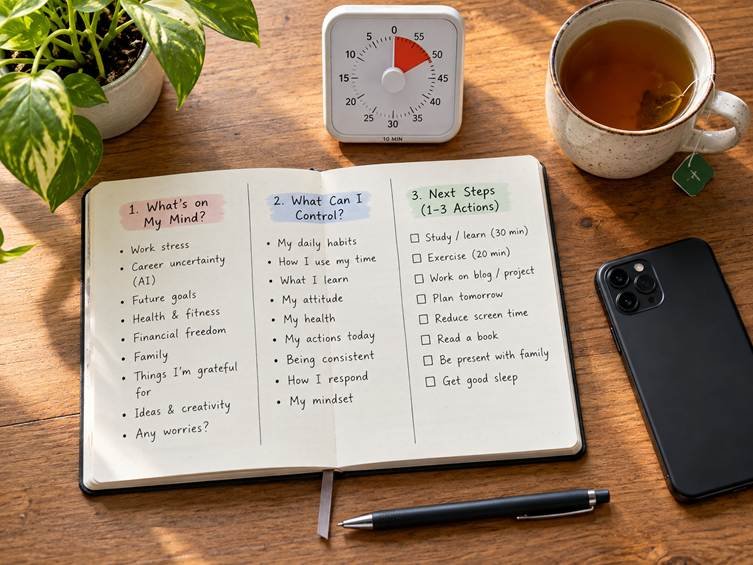
You need a notebook or a notes app and ten uninterrupted minutes. Use a timer so the session has a clear end.
- Pick a fixed time. Late afternoon or early evening often works. Avoid the last hour before bed and avoid journaling right after reading AI news, which tends to load up the worst-case scenarios.
- Brain dump (about 3 minutes). List every AI or job worry on your mind, in fragments if you like. Don’t edit or argue with them yet.
- Pick the loudest one and check it (about 3 minutes). Write the fear in exact words, then ask: What specifically am I afraid will happen? What’s the evidence? What’s the most likely outcome, as opposed to the worst one?
- Sort it (about 2 minutes). Divide the worry into three short lists: what I control, what I can influence, and what I can’t control.
- Choose one next step (about 2 minutes). Pick something small from the “control” list that you can do this week. Write it down with a day attached.
- Close and postpone. When the worry shows up later, jot a word or two on a “for tomorrow” list and remind yourself it has a slot. Then return to what you were doing.
Rate your anxiety from 0 to 10 at the start and end of each session. Over a few weeks, those numbers tell you more about whether this is helping than any single session will.
What should I write in a worry journal?
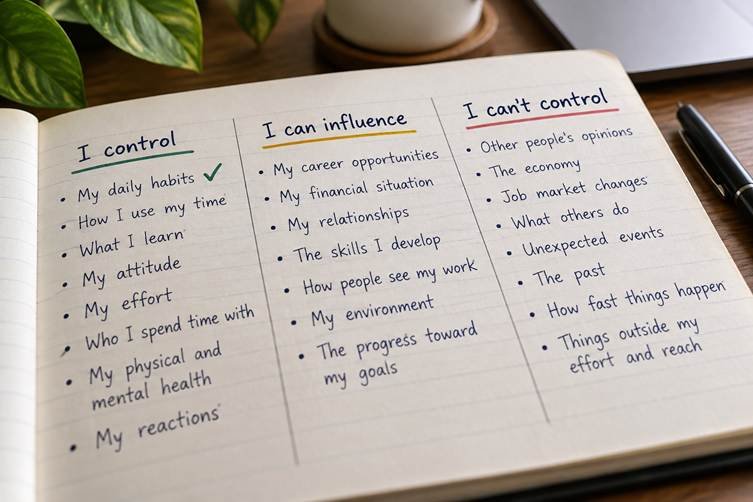
A worry journal works best with the same handful of fields each time. Repetition makes the process faster and makes patterns easier to spot when you look back.
Useful fields include:
- Trigger: what happened right before the worry spiked
- The thought: the fear in your own words
- Anxiety rating: 0–10
- Evidence for and against: facts only, not predictions
- A more balanced version: realistic, not falsely positive
- What’s in my control: even small things count
- Next step: one action with a day attached
Here’s an illustrative example of a completed entry. It’s a composite written for this guide, not a real person’s journal.
Trigger: In a team meeting, my manager demoed an AI tool that drafts reports.
Thought: “This does half my job. I’ll be gone by next year.”
Anxiety: 8/10
Evidence for: The tool produced decent first drafts.
Evidence against: It needed my corrections on numbers and context. Nobody has mentioned headcount. My role also includes client calls and judgment calls the tool doesn’t touch.
Balanced version: Part of my work is changing. I don’t know the timeline, but “gone by next year” is a guess, not a fact.
In my control: How quickly I learn the tool. Asking my manager how they see roles changing.
Next step: Use the tool on one report this week and note where it falls short.
Anxiety after: 5/10
Notice that the balanced version doesn’t claim everything will be fine. A reframe you don’t believe won’t calm you down. One that’s accurate usually holds up better.
Journal prompts for AI anxiety
These starter prompts cover the main jobs of the journal. Pick one or two per session rather than working through the whole list.
To get the worry out of your head
- What exactly am I afraid AI will do to my job? Be as specific as possible.
- When did this worry show up most strongly this week, and what set it off?
To check worst-case thinking
- What’s the worst case, the best case, and the most likely case?
- If a colleague told me this fear, what would I point out to them?
- What do I actually know about how my company plans to use AI, and what am I assuming?
To separate control from noise
- Which parts of this situation can I influence this month?
- What am I spending energy on that I genuinely can’t change?
To keep perspective on identity and values
- What parts of my work do I value most, and which of those depend on judgment, relationships, or context?
- Who am I outside my job title?
To turn worry into action
- What’s one skill, conversation, or piece of information that would make me feel 10% more prepared?
- What would I do this week if I assumed my role will change but not disappear?
For a larger set organized by situation, including prompts for after a layoff announcement or a performance.
Common journaling mistakes that can backfire
Journaling can quietly turn into another way of worrying. These are the patterns to watch for.
Writing the worst case every day without questioning it. If every entry rehearses the same disaster in more detail, you’re practicing the rumination you’re trying to break. Make sure each session reaches the evidence and next-step stages.
Rereading old entries for reassurance. Looking back occasionally to spot patterns is helpful. Rereading entries repeatedly to calm yourself down tends to work like other forms of reassurance seeking: short relief, then the urge comes back.
Forcing positivity. Writing “AI will never replace me” when you don’t believe it usually doesn’t stick. Aim for statements that are fair and true.
Journaling with headlines open. Checking AI news mid-session floods the page with new worst cases. Keep research and journaling separate.
Making the action step too big. “Learn to code by Friday” sets you up to feel worse. “Watch one 20-minute tutorial on the tool my team uses” is something you’ll actually do.
When journaling isn’t enough
Journaling is a self-help tool. It isn’t a substitute for professional care when anxiety has become more than everyday worry.
Consider talking to a doctor or licensed mental health professional if, for several weeks, you notice any of the following. Persistent or excessive anxiety can interfere with everyday activities, including work, relationships, sleep, and concentration. NIMH guidance on anxiety disorders provides information about symptoms and when anxiety may require professional support.
- Worry most days that feels hard to switch off
- Trouble sleeping, constant tiredness, irritability, or difficulty concentrating
- Panic attacks, or physical symptoms like a racing heart or tight chest when work comes up
- Avoiding work tasks, emails, or meetings because of dread
- Relying more on alcohol or other substances to cope
- Low mood, loss of interest in things you used to enjoy, or a sense that nothing will get better
Good places to start include your primary care doctor, a licensed therapist (CBT is a common approach for anxiety), or your employer’s Employee Assistance Program if you have one, which may include counseling sessions. In England, adults can also self-refer to NHS Talking Therapies for anxiety and depression without first speaking to a GP.
If you’re having thoughts of harming yourself or feel you can’t stay safe, seek urgent help. In the U.S., call or text 988 Suicide & Crisis Lifeline for crisis support. In the UK, use NHS urgent mental health help or call 999 in an emergency. In Canada, call or text 9-8-8 Suicide Crisis Helpline. In Australia, call Lifeline on 13 11 14 or call 000 in an emergency.
Frequently Asked Questions
How long does it take for journaling to help with anxiety?
There’s no fixed timeline. Some people feel a little lighter after a single session simply from getting thoughts out of their head, while changes in how often worry intrudes usually take longer to notice. Tracking your 0–10 rating for two to four weeks gives you a clearer answer than going by how one day feels.
Is it better to journal on paper or in an app?
Either works, so choose the one you’ll use. Paper keeps you away from notifications and news, which helps if your phone is where the anxiety starts. Apps make entries searchable and easier to keep private behind a passcode.
Can I use an AI chatbot to journal about AI anxiety?
A chatbot can suggest prompts or help you organize your thoughts, and some people find that useful. Before sharing anything personal, check the tool’s privacy and data-use settings, avoid entering confidential employer information, and remember that accounts on work devices may be visible to your employer. For example, if you use ChatGPT, review OpenAI’s Privacy Policy before sharing sensitive information. A chatbot is not a therapist and shouldn’t replace professional support if you’re struggling.
Does journaling help if I’ve already lost my job to automation?
It can, but the focus shifts. After an actual job loss, it’s normal to feel grief, anger, or shame alongside worry, and writing about those feelings directly may help you process them. Pair that with practical entries covering finances, next applications, and who you can ask for support, and see the warning signs above, since job loss is a major stressor. A dedicated guide is planned.
Can journaling make anxiety worse?
For some people, at some times, yes. Expressive writing studies have found that people often feel more distressed right after writing, and journaling that only rehearses worst cases can feed the worry loop. If you consistently feel worse after sessions for more than a couple of weeks, shorten them, add more structure, or try a different approach with a professional’s help.
Start with one 10-minute entry

AI’s effect on work is uncertain, and no notebook will change that. What a structured journal can change is how much of your day the uncertainty takes up, and whether the worry ends in a next step or just loops back. Choose a time today, set a ten-minute timer, and work through one worry from brain dump to action. If after a few weeks the anxiety is still running your days, that’s useful information too, and a good reason to bring in professional support.